The Fourth Wave
Short Story
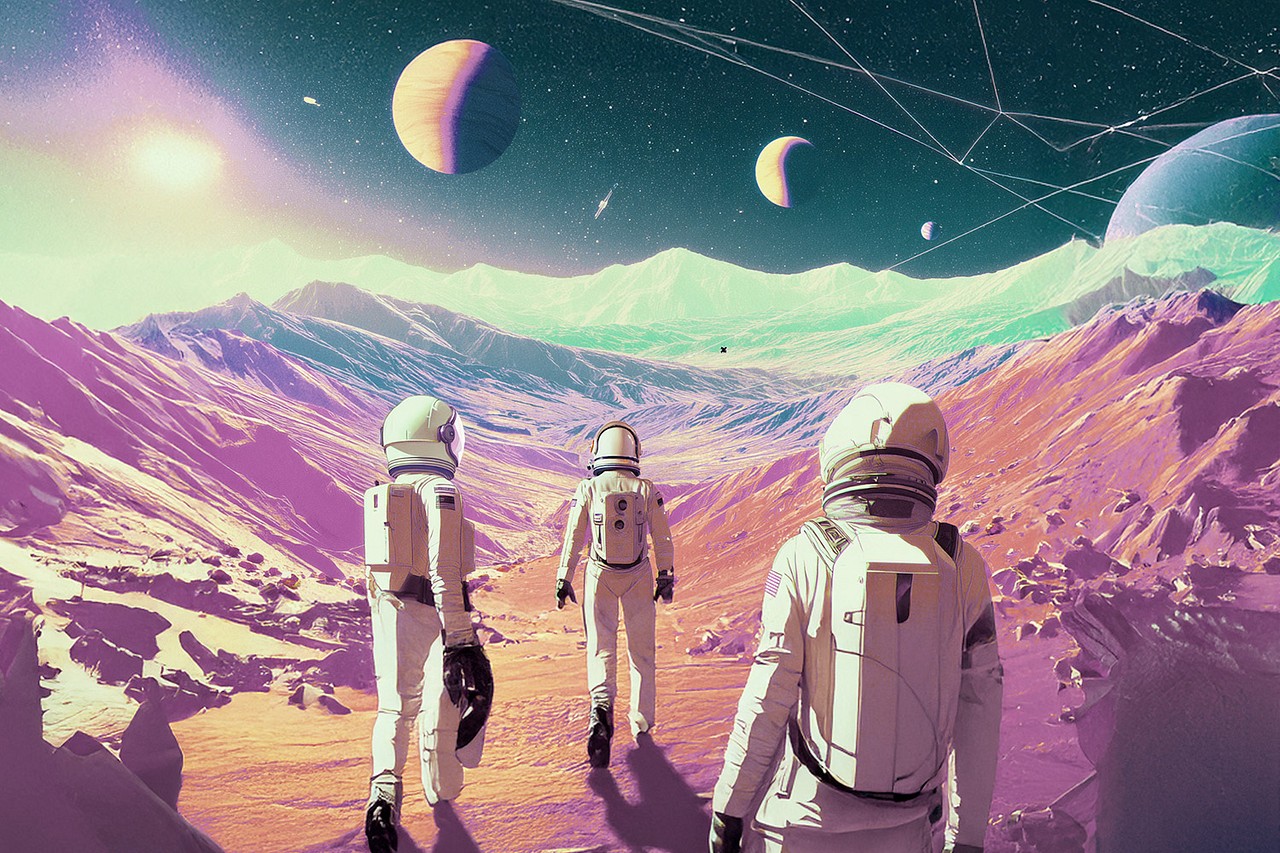
A tribe of human civilisation, the Procyonites, embarks on a journey to colonize a new star system, facing the challenges of space travel and social development. Pioneering the galaxy. Paving the way for 15,000 more waves to come.
Read: 26 min ✧ Words: 5,111 ✧ Chars: 33,846
It appeared on every news channel in the morning. The ships were ready—an exciting moment for the colony, which had been working toward this event since its founding, now 823 years ago.
Fourteen-year-old Mijk was sitting at breakfast when the news about the ships appeared on his lenses. He often woke up early, so he could get into the bathroom and to the food modeller before his three sisters. In their large household, meals were often cooked manually. His mother Magret and a few others in their shared living group had developed a passion for cooking. So the modeller was rarely used for lunches and dinners—if at all then mainly to produce certain ingredients. In the mornings though, for breakfast, everyone used it.
Mijk listened attentively to the report and afterwards opened the stream of additional information. He was utterly fascinated by the spaceship project. For as long as he could remember, progress on its construction had been a constant topic in the news. But he had every bit of additional information stored in his mind—from the planned blueprints and the navigation methods on the bridge, all the way to the propulsion technology—he absorbed everything.
Cleary delighted, he ate his muesli while his sisters gradually trickled in. Gena, who was only a year older than him, was the last to climb out of her bunk. She was a late riser. His two other sisters were already twenty—twins, who always had their heads together wherever they went. Mijk found them somewhat exhausting.
“Time to go!” his mother shouted from the next room, then burst through the door. School was waiting.
Mijk and Gena set off. They passed through five corridors and four sections until they reached their school. Most days, like today, they took the commuters—small, self-driving platforms they could stand on. In the station's intelligent routing system, the platforms handled every request of their passengers autonomously. That way the school run took only a few minutes; on foot they sometimes needed half an hour.
Every other day, they could attend lessons from home anyway. The colony simply didn’t have enough physical room for all students. Mijk, who was a model student, didn’t understand why his mother and the others in their commune thought live attendance was so important. Most of the time he understood everything immediately and never needed to ask questions that required a teacher to be in the same room.
But today, they wanted to be at school as early as possible. The ships were the number one topic before class. Everyone was talking about them. Mijk—the grand expert—knew the most and was practically squeezed dry for information by the others.
“Please make your way to the large assembly room,” a voice echoed through the corridors. It was an announcement broadcast from Professor Greger, the current principal. “The first lesson is cancelled today. I have something important to tell you.”
Normally, all information appeared as short messages on their lenses. Mijk couldn’t recall ever having heard a spoken announcement from those loudspeakers. Many didn’t even know what the grated ceiling fixtures were for at all. After the announcement, several seconds of uneasy silence followed. Then the murmuring returned—and grew even louder. It only stopped when an alert appeared on their lenses, telling them that lessons were about to begin.
“823 years,” Greger began solemnly. “Exactly 823 years ago today, the settlers of the third wave—our ancestors—arrived here in this system. Only 12,000 people made it here back then.”
Mijk was already bored. Greger was starting far too far in the past. That he went all the way to the beginning was too much. He might as well have started with the first preparations for the first wave. They had already covered all of that dozens of times in lessons.
“In the meantime,” Greger continued, “there are now over 2.3 million of us in the Procyon system. Here on Racoon alone, in your neighbourhood, 800,000 people are currently living. But no one back then could have foreseen that. Our predecessors had to endure many hardships. They found no habitable planet around our star and instead selected two small sheltered regions on the most suitable chunks of rock they could find, and began building everything up from scratch.
Today—you have surely already seen the news yourselves—it is time for a new mission that, just like back then, leads into the unknown. Our Polis has therefore requested that the following must be delivered verbally to every student. Myself and your other teachers are of course available for any questions you may have.”
Again, a wave of murmuring broke out, which the principal silenced with a simple gesture.
“The Polis of Racoon and Loton,” Greger read, “have unanimously decided that our shared mission should enter its next phase. The ships are ready. It is now time to plan the new objectives in detail and—just like our ancestors—to select 15,000 pioneers who will set forth into a new world.
Exactly six years from today, the two ships will launch and travel through space for a long time, until their passengers become the first to set foot on new soil.
In order to give this pioneer generation the best possible starting conditions after a long journey, it is necessary to select people as young as possible and prepare them perfectly for this extraordinary situation.
On the ship, places will primarily be reserved for the current generation of 12- to 18-year-olds.
Whether you, dear students, will be among them—you will find out later today. We will soon be sending invitations to 10,000 young people.”
Mijk knew the mission almost by heart. He also knew they were recruiting younger people, but he didn’t think his age group would be involved. Then came numbers—and numbers were his favourite toy.
Ten thousand adolescents. That meant roughly one in ten in his age group. The ships could each hold 8,000 people without trouble. So for 5,000 pioneers there was more than enough free space—but of course several thousand specialists were needed to complete the journey and continue educating the youth.
They spent the whole day on the schoolyard speculating about every aspect of it. After the announcement, there was no chance of normal lessons resuming.
In the evening, the whole house sat down for dinner. In their home, alongside his relatives, lived two other women and two men around his mother’s age with their children. The older generations were also part of this multi-generational household, as had been customary on Racoon for centuries. Today, no fewer than fourteen people were seated around the table.
Suddenly, in the middle of the meal, a message appeared on his lens. Almost at the same time, he and his sister Gena jumped up from their chairs and let out a shout of joy.
“I’m in!” they yelled, loud enough that Henka, Mijk’s grandmother, almost choked. Unluckily, she was sitting right between the two.
After that, they had to report in detail to everyone at the table. They had already told their mother shortly after school, and some reports had already come in via the lenses. Still, everyone wanted to know exactly what was going on.
“It says here,” began Mijk, “that starting next week we’ll be allowed to attend a different school. We'll still be able to learn a lot of things from home, but we will have direct personal contacts for everything—teachers and trainers who are there just for us. If we want, it says.” He snorted. “What kind of question is that? Of course we want to, right, Gena?”
Even though families were large and the individual bonds somewhat looser than they used to be on old Earth, you could still clearly see the disappointment on Magret’s face, Mijk’s mother. She would lose both children. It would still take six years, but then they would be gone.
“Hello, Mijk,” said the man through the lenses about half an hour after dinner, “I’m Gowen, your instructor.”
“Good day,” replied Mijk, not quite understanding.
“Each of the ten thousand has been assigned a personal instructor,” the man continued. He was tall, dark-skinned. He looked almost too perfect. It was nearly impossible to estimate his age.
“No, no,” Gowen seemed to read Mijk’s thoughts. “I’m not a Neuro, people have said that to me a lot. I’m used to it. No—I’m a normal human being, and I’ll be at your place in about five minutes. I want to show you something.”
Mijk had stood here once before—at the place where the third wave landed, here on Loton. But this time, Gowen told him a slightly different version of the story.
The first wave went back to an idea conceived by a man named Marc van der Venden, the President of the United Nations, in the 23rd century of Earth-time. It was the first program that would extend beyond the lifetime of his own generation—remarkable. After all, its final goal would only be reached after 500,000 human generations. But at that time, just as in Mijk’s time, almost nobody truly believed in it.
It was about breaking out into the Milky Way—exploring and settling every single potentially livable planet. He planned all of this over many years together with a team of physicists, engineers, sociologists, and political scientists — using comprehensive but simple and realistic methods. If new technology sped up the mission, all the better. If obstacles arose—personal or catastrophic—that hindered the project, then at least they had tried.
And so they built their first generation-ship. The resources and conditions were not always stable, and so it took them 700 years to complete—300 less than van der Venden had allotted for each wave.
The first ship set off toward Alpha Centauri as the Solar system already had five human colonies. In addition to Earth, humans had settled Mars, the Moon, Titan, and the eternal ice of Jupiter’s moon Europa.
After another 1,200 years, the second wave succeeded, while Earth itself had already conquered another planetary system. In the centuries that followed, the colonies were just as active as the people here at Procyon. Only around 60 years ago came the announcement through the space-channels that the 14th star had been successfully colonized.
By now, the diameter of the human sphere of influence reached almost 20 light-years. All colonies constantly exchanged data, though physics remained unchanged — it still took 20 years for important information to reach the other systems.
Since Procyon lies about 12 light-years from Earth, the information received by the residents of Racoon and Loton lagged accordingly far behind. “In some areas on old Earth,” Gowen chuckled as he explained it to Mijk, “even today it takes longer for progress to arrive.”
“But we ourselves here on Racoon,” Gowen continued proudly, “have made our own technical achievements and discoveries which other colonies have adopted from us. Our modellers can autonomously build livable structures in the shortest time at any gravitational level—even in zero-gravity.
Since we have no planet with atmosphere here, unlike most others, we had to specialize in domes, platforms, corridors, digging into rock, and developing powerful protective shields against meteor-showers.”
Racoon, like Loton, is not very large and its gravity is rather weak. Mijk weighs only half as much here as he would on old Earth. And later during the acceleration phase of the flight, the same gravitational forces of 1g exist. That is why all pioneers had to constantly train to build up their muscles.
“Even though by now we possess every conceivable kind of technology to survive even under the most hostile conditions,” Gowen lectured further, “it doesn’t mean that life there will be easy. In the star systems where habitable planets with atmospheres were found, live now twenty times as many people as in artificial habitats.”
It was a joy talking with Gowen. For Mijk it never felt like schooling. He absorbed everything technical—and also the social and cultural topics fascinated him deeply: how would people live together, what form of government would make sense…
Sometimes he and his sister Gena combined their lessons. Whenever they did, he noticed that each of the 10,000 pioneers received a customized curriculum perfectly aligned with their interests and needs.
Long before the ships were even completed, many experts had debated which would be the ideal star. What would be the destination of the journey? Which planetary system should humanity conquer next?
“The choice was actually easy,” Gowen began his description of their future home. “Luyten’s Star isn’t as strong or as large as Procyon — in fact, it’s a red dwarf, one of the smallest classes of stars that exist. But in return, the system is pleasantly calm. The star is stable, emits few eruptions, and casts a warm light.
And it is only 1.2 light-years away. That means your journey will be much shorter than that of the pioneers who arrived here 800 years ago. You’ll be travelling only twelve years.”
“Luyten’s Star even has planets with an atmosphere,” Mijk replied eagerly.
“Yes, Mijk. The probability is high that someday you will be able to get rid of glass-domes and walk openly upon the planetary surface. Certainly not your generation of pioneers — but your children or grandchildren. They will have it comfortable.”
The year of the launch of the two generation-ships was something special for the Procyonites. Many festivals and celebrations were interspersed between the numerous preparations and training sessions to attune them to the great journey ahead.
More and more frequently, Mijk and Gena were out in space. In small gliders they were brought to the spaceport, from where they conducted reconnaissance flights within Procyon’s solar system and its slightly dimmer companion star. They primarily had to prepare for life conditions during the long journey, but also learned how to plan and build new habitats on suitable rocky planets.
Now there were only twelve days left until departure. It was Mijk’s nineteenth birthday. What a coincidence: for today, his moving into the ship was scheduled. Every pioneer was assigned a different date, so that there wouldn’t be too much traffic and logistical chaos around the spaceport and within the ship.
For Mijk, the organizers made an exception—and allowed the entire family to come aboard for the day. The whole commune had been planning a combined farewell-and-birthday celebration for several days already. It became a warm-hearted evening. But, however, it had to end in a farewell forever. Mijk did not find that nearly as distressing as his mother did—or, more surprisingly, as his two older sisters seemed to.
After all, they would remain in direct communication for a long time—even later still, though with a year’s delay. For Mijk, it was time anyway to detach from his family and stand on his own feet. He had been prepared for that for the last six years.
Furthermore, it didn’t feel like a farewell to Mijk at all. They invited their new neighbours—the residents of the adjacent habitats on the ship. Some he already knew from training; others he met for the first time that evening. Of course, as birthday child and centre of attention, he was introduced quickly to everyone. At times, the attention almost became too much for him—with a note of nervousness for launch day mixed in.
The next day, when all the guests had been flown back to Racoon, he was glad to have a few minutes on his own in his habitat to enjoy the silence.
“You and your new colony,” Gowen began his last lesson. “Yes—it will be your colony, Mijk. You will be one of the founding fathers, and I envy you for that. But I’m at least glad to have contributed a small part.”
“Gowen,” replied Mijk, “you’ve taught me everything I need to know. You have an extraordinary share in all of this. And now you’ll surely be appointed to work on the next generation of ships. You’re one of the most important Procyonites, if you ask me. And a good friend.”
“I’m touched,” Gowen answered. “But what I truly want to tell you is this. You and your colony—you will have a vital influence on how it will function, on what happens in your first thousand years, whether you survive everything, and how resilient you will be. You know the history of Sirius — the failed mission that tore itself apart in brutal war.
If I could make one wish, it would be that you create a peaceful, prosperous world—one into which my grandchildren and great-grandchildren may one day follow you.
Van der Venden, who planted the idea of conquering the Milky Way into humanity’s mind over 2,800 years ago, did so in the only right way—by ensuring that wars, dictatorships, and the hunger for power would not destroy it.
Today there are fourteen star colonies of humanity. No dictator or tyrant can seize all power over all humans anymore. The distances are too great—which significantly increases the probability that humanity will survive its crises.
No matter how hostile the conditions may be—or conversely, how beautiful and livable your world might become—there is only one great goal: Hold to it and build a ship with which you will send pioneers on the next journey to discover the next world. You are the fourth wave—but there must be 500,000 more to fulfil the entire mission.”
The day of the launch arrived. Mijk was extremely excited, although he actually had absolutely nothing to do except check his special seat in the launch chamber about twelve more times, the sat which made the strong g-forces of liftoff somewhat more tolerable.
Gena had the seat right next to him, but she didn’t show up until around noon. She somehow had the nerves to fall asleep even on this day—calm until the very last moment. Enviable, thought Mijk.
Getting 10,000 adolescents aligned and unified under a single mission had been a massive undertaking. And of course, participation was voluntary. Over the past six years, more than 3,000 pioneers had dropped out or been deselected. They attempted to compensate through additional nominations. On top of that came more than 4,000 specialists—from professors to navigators to entertainers—who were indispensable for the flight and for the later development of the new society. But most of all, the pioneers benefited from the Neuros—the artificial intelligences that controlled nearly all of the highly complex systems for flight, life support, and service.
In the end, the generation-ships had 12,880 passengers. And all of them—including the pilots—sat strapped into their g-seats 20 minutes before launch. The seats regulated blood pressure and oxygen supply. Everyone was waiting. The Neuros were working at full capacity on the final launch preparations.
Being connected to the monitoring systems was something Mijk had gotten used to. During the last year they had performed a total of eight test flights, reaching each time the maximum acceleration of 8 R—eight times his body-weight on Racoon. Over 400 kg pressed onto the body in those moments. Now he would face that again. The main difference this time was the duration. With two short breaks every four hours, they would have to endure this strain for the next twelve hours.
At first, however, they would transition through a phase of weightlessness. The rotors that generated gravity were switched off now. He noticed how he became steadily lighter. A queasy feeling in his stomach announced it.
“One minute until disengagement,” the Neuro reported over the speakers. They had to remove their lenses for the launch phase. Announcements and external monitors were now their only means of communication.
Then the main boosters fired and caused vibrations all across the ship. At the same time—now entirely weightless—Mijk felt a jolt accompanied by a tremoring roar. They were detached from the docks. The journey had begun.
Seconds later, the maneuvering thrusters fired and pushed a portion of gravity back into his body. His stomach reacted to each change and rewarded him with a wave of mild nausea.
The ship drifted several hundred meters away from the spaceport into the void. They watched on the monitors as the station grew slowly smaller.
After five long minutes during which both of the gigantic ships aligned themselves properly the enormous boosters ignited and the pioneers were pressed into their g-seats as if a giant block of concrete were thrown onto them.
The Ebbighausen—Mijk’s ship—shot out of their home system parallel to the Luyten, its sister-ship. The first acceleration phase was crucial because it allowed the combination of all three propulsion systems to be used to reach their travel speed of ten percent of the speed of light: solar wind, laser sails, and finally the powerful ion-booster.
Only when Mijk paid very close attention, and forced himself through the gravity to adjust the external camera-feed on the monitor, he could make out the massive sails that stretched like an umbrella over the long habitat-cylinders.
T plus 12 hours.
“We did it!” shouted Gena first, somewhere in the section beside him. “The boosters are turning down!”
Second by second, they felt more and more weight lifting off their shoulders. From now on they had to adapt to what was left—the constant travel acceleration, which was twice that of Racoon’s gravity. That adjustment would take time. Mijk remembered that during the journey they would experience roughly the same forces as on old Earth, if Gowen was correct. It must have been exhausting to live there, he thought.
Nevertheless, they could now unbuckle and move around normally. At first a bit clumsy and heavy-legged, they quickly adapted throughout the next weeks.
After the first day they had reached a travel speed of 1,200 km/s. From now on they would add around 500 km/s each day until they reached their cruising velocity of about 30,000 km/s.
Six months under heightened gravity — Mijk had gotten used to it quickly and built up muscle accordingly. Still, he sometimes longed for a bit less resistance with every movement.
Today was the day. They had reached their travel speed and from now on would move without further propulsion. The boosters were shut down. For a short time they were weightless again until the cylinders’ rotors started up and once more settled the pioneers into their accustomed Racoon-gravity.
It was a joy to float weightlessly through the corridors. But once gravity returned, everyday life began. At least there were some areas within the interior of the cylinders where zero-gravity prevailed.
Together with forty other pioneers, Mijk was being trained to become an architect. Architects were not primarily responsible for designing and constructing buildings, that was merely a side aspect. Rather, this team was responsible for the settlement and terraforming strategies of their new homeworld—one of the most critical tasks, architecting their future. Numerous other specialists would support them in determining suitable settlement sites, making planets habitable, or constructing habitats in underground caverns.
Gena, ever sociable, had already befriended some of their neighbours and her own work group, and had to pull Mijk along a little — he had always been more of a loner back on Racoon and rarely went out. But the ship offered plenty of variety. Very close to their habitat-area there was a pub, and it soon became tradition to go there once or twice a week and meet up with the others.
Some earlier lessons on Racoon had also dealt with social life. A new society was to be built with only 10,000 people, genetic diversity had to be ensured early on. It had been the same on Racoon already, but for this small group it was even more critical. Each female pioneer was therefore ideally supposed to have as many children as possible with different men. That naturally affected social structures. Families would grow larger, family membership and composition would change faster, and bonds would be more fluid.
Gena embraced this early. She fell in love with one of her colleagues in the ship’s biological laboratories and became pregnant. Six years after launch, roughly halfway through their journey, Mijk became an uncle. Elika, his little niece, was by far not the first baby born aboard the Ebbighausen. There were already over one hundred young spacefarers.
Mijk initially rather focused on his work. After ten years of travel, the astronomers could deliver the first detailed data of Luyten’s Star and its planets. They could determine their statistical numbers, which moons had suitable sizes, and what atmospheres existed. Valuable information, because this enabled simulations that allowed them to preselect a suitable landing and settlement site even before they could see the system with their own eyes.
Later, Mijk also formed bonds while becoming a valuable crew member. Arin, his girlfriend, was his age and, like Gena, worked in the biological division. She tended the arboretums that regulated oxygen levels within the habitats.
“You’re always so absorbed in your work,” Arin said one evening.
“There’s so much to prepare before we land,” Mijk replied.
“Come on, I’ll show you something,” she answered simply. Mijk was puzzled — and curious.
They walked down a corridor. Two habitat-zones away was a large biological laboratory.
“Up here,” Arin pointed to a small freight elevator that led toward the ship’s center.
They rode up—the lift disengaged—and suddenly weightlessness set in. Through the ceiling they could see a vast, dim hall as the lift doors opened. Mijk felt a flutter in his stomach.
“Those are my trees,” Arin finally said. “Come on—push off with me.” They drifted toward the treetops. Arin was skilled at navigating in zero gravity and eventually Mijk began to enjoy it too.
“Lights off,” Arin instructed the Neuro after some time, having examined the buds of the trees. “It will start in a moment,” she said to Mijk.
It was completely dark at first, but after a few seconds Mijk noticed a pale glow that became stronger and stronger. Filament-like, the milky light drifted through the air.
“The spores,” Arin explained, “we make them glow so we can control the process better. I think it’s beautiful.”
“How long does the effect last?” Mijk asked.
“About an hour,” she said. “Then we draw the spores back in.”
Mijk pulled Arin close. “Then we have an hour,” he said.
During the journey, the crew could send messages home at any time. But as the flight went on, the response time grew longer and longer. By now, a transmission took over a year. Information from the other colonies also constantly arrived, reports of new discoveries, political developments, or catastrophes. The largest stream of data still came from Earth.
Their own mission, however, proceeded like a textbook example. First, the ships had been finished much earlier than planned in the Procyon system. After twelve years of travel without major incidents, they finally arrived in the system of Luyten’s Star. Mijk and Arin had been relocated shortly before arrival to one of the accompanying reconnaissance ships and could take a look at the solar system earlier than the others. They found a total of six rocky planets with suitable gravity, three of them in the habitable zone. One of these even had an oxygen-bearing atmosphere. It would still take several generations until it was directly habitable—nevertheless, compared to other missions and to their old home on Racoon, one might already call it a paradise.
During the voyage, 10 of the 12,880 people had died, while many of the young families were already contributing urgently needed offspring. They arrived with more passengers than they had departed with.
Mijk had been appointed to the Great Council, the body responsible for making decisions during the transition period. Naturally, they chose Luyten 3, the planet with the oxygen-rich air, as their new home planet .
“Welding will be difficult,” began Klas, an engineer from Mijk’s team. “The oxygen concentration is very high.”
“True,” Mijk confirmed. “At first we should only let Neuros and modellers onto the planet. They can assemble the habitats. We’ll move the manufacturing to the moon. There are enormous metal resources for construction, as well as stone for glass production. We should possibly use the main reactor from one of the ships at first, so that we don’t have to build another energy source.”
“But what are people supposed to do in the meantime?” asked Iossi, another colleague.
“Everyone stays on their ship for a little longer,” Klas said. “We expected this. The solar panels provide sufficient energy for life support. Some auxiliary systems would need to be shut down.”
“You’re saying nobody should go down at first?” countered Arin, Mijk’s girlfriend, who also took part in the planning. “But we need to start the breeding and planting projects as soon as possible. We need breathable air.”
With visibly pregnant belly she sat in the auditorium of the scout ship and presented the plans of the biological team. Much of the work would again be handled by the Neuros. But their task would now need to invert completely: instead of oxygen-producing plants — like on the ships and the habitats of Procyon — organisms had to be used that consumed oxygen, filtered toxins, produced greenhouse gases in the required quantities, and thus created a viable atmosphere. But for this process, supervision was unavoidable. “One must feel it,” she said.
In the end, they opted for a small outpost and a mobile accommodation—a large, flying caravan, so to speak—into which Mijk and Arin moved, along with four other scientists.
Anno 840 in Procyon-time became year 1 in Luyten-time.
Three months after arrival, Nika was born. Mijk and Arin’s daughter was officially the first Luytener.
Although the Neuros ensured perfect care of the heavily pregnant Arin and monitored the birth flawlessly, complications arose. Arin died only a few days after Nika’s birth.
For a short while, Mijk collapsed and fell into deep depressions. After that he quickly lost himself in his work and caring for Nika, which left him no idle time.
“We have great fortune,” he said at the funeral, seemingly moved. “Our new home, rough as it may seem, is the perfect place for a new beginning. Everything here is emerging. But we must also make great sacrifices. And we should never forget that.”
About a year later the habitats were ready, and the pioneers could move in gradually. Mijk and Nika traded their temporary residence—the “campervan,” as they called it—for a permanent home and moved in with Mijk’s sister Gena, his niece Elika (now seven years old), and several others into a shared commune in the city they named Ebbig—named after their ship, which in turn had been named after Ebbighausen, one of the discoverers of the star system.
In total, the council had planned eight medium-sized habitats distributed across the large main continent — four of them situated by the water. Rapid communication lines and permanent transport systems connected the settlements.
Life in their new home had begun. Initially rough and unfamiliar — but with the potential for paradise.
They speak of waves—but nobody I’ve asked still knows what that word even means.
In any case, today is a historic day. Today we arrived in the Rahl star system and landed on its fourth planet. Officially, this completes the 5000th wave.
Information streams in constantly from thousands of star systems. All of it has been sent out at different times. Our machines filter it for us and produce what they claim to be an objective history of the Milky Way. I don’t trust the machines very much anymore—not since we intercepted some of the transmissions ourselves with our own radio phalanxes.
I believe some of the other colonies are already controlled by machines. We should build machines whose only task is to supervise the other machines—let them fight among themselves. Sadly, we cannot manage without them, because the clock is ticking. We have a colony to awaken and another ship to build.
They also speak of the old Earth, the planet where it all began. They say it was destroyed a million years ago. Yet many here on the ship and in the incoming reports still speak of Earth as if it were a sacred place. Our star maps still record the Solar system. From here it lies 12,500 light-years away and seems to belong to the territory of an alliance that calls itself Luytena. But how can one trust information that is over 10,000 years old?
I suppose we should still be grateful that we have a node in the information network of the galaxy. Almost one quarter of the Milky Way is now inhabited by descendants of Earth — or by their machines. Surely there are regions by now where all memory of that origin has been lost entirely. Or—perhaps—those people are better off?
They speak of aliens and still call them extraterrestrials, as if there were anything terrestrial left in us at all.
So far, we have encountered none—or so the machines tell us. What we have found on countless planets are billions of microbes, innumerable algae-forms, and thousands of varieties of grasses.
Up above us here, there is a moon completely overgrown with fungus-like structures. Unfortunately uninhabitable. Its spores make terraforming impossible for centuries to come.
But there is one rumour that persists. The machines report that on some missions—not a small number—technological constructs were discovered that at least indicate another civilisation. We have even seen images. They looked heavily decayed, but with some imagination one can still recognize the engineer behind them. But there's no sign of the beings themselves. Perhaps others had the same idea millions of years before us. Perhaps they even passed by mythical Earth.
They also say that nothing exists forever.